467 peatland researchers and practitioners have agreed on the peatland research priorities that should shape the field for the next decade. The 50 questions cover carbon, restoration, governance and equity, and the list has just as much to say about people as about peat.
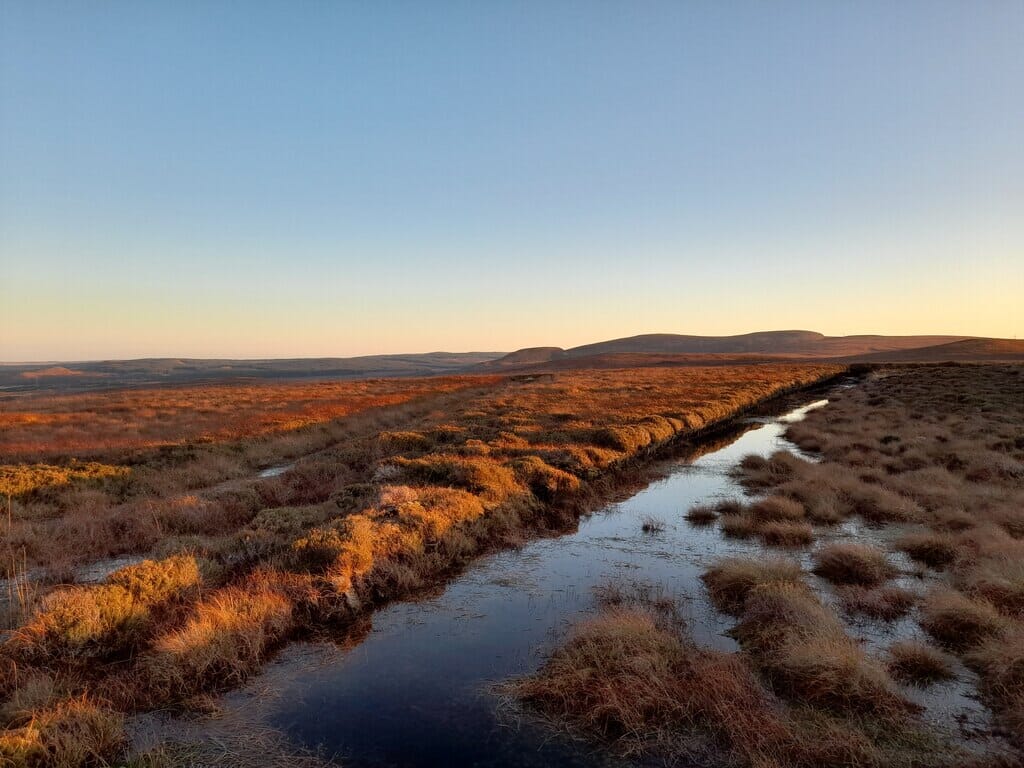
Peatlands cover only 3 to 4% of land but hold roughly a third of the world’s soil carbon. When drained, they release between 5 and 10% of annual human-caused CO2 emissions. Despite this, peatlands have received less research attention than forests or coral reefs, and a new paper in Communications Earth & Environment sets out the gaps that need addressing.
Led by Alice Milner at Royal Holloway, the study asked the global peatland community what it most needs to know. People from 54 countries submitted questions through a survey translated into 21 languages, and a panel of experts then ranked them. The result is the first community-driven research agenda for peatlands.
But the basics are still unsettled
Several of the priorities are questions you’d think we’d already have answered. How much carbon do peatlands store globally? Where are they all? How do emissions vary by peatland type and degree of disturbance? Total area, peat depth and carbon accumulation rates remain uncertain, particularly in tropical regions like Indonesia and the Congo Basin where peatlands are still being mapped. Layered on top of this are questions about how warming, fire, drought and changing land use will push peatlands towards tipping points, and which peatland systems are most at risk.
Restoration is the largest single concern
More than half the priority questions concern restoration, governance and equity. To meet Paris Agreement targets1, an estimated 500,000 km2 of drained peatland needs restoring by 2050. Researchers want clearer evidence on which techniques work, how long recovery takes, and how to weigh restoration against food production and local livelihoods.
The policy questions are pointed. How do carbon credits actually translate into stored carbon? How can Indigenous knowledge and community rights be integrated into restoration design? How do you reconcile contradictory policies (the EU, for instance, still subsidises farming on drained peat while paying for restoration elsewhere)?
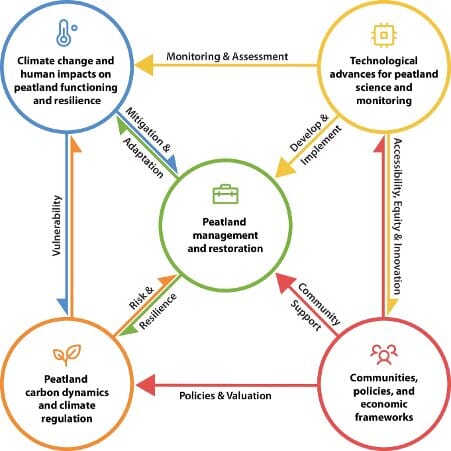
What the peatland research priorities mean for how the field needs to work
Across all 50 questions and one thing is clear: the questions peatland researchers most need answered cut across ecology, hydrology, climate science, social science, economics and policy. Remote sensing and AI are mentioned, but so are community participation, equitable benefit-sharing, and policy coherence across scales. Answering these questions will need long-term observatories, shared data infrastructure, and genuine collaboration between scientists, governments and the communities living around peatlands.
That work is already underway at the Climate + Co-Centre. Dr John Connolly, one of the paper’s co-authors and a geographer at Trinity College Dublin, leads the Co-Centre’s Multi-scale Environmental Assessment of Upland Natural Capital, which combines satellite, drone and ground-based data to track how peatlands and other upland habitats respond to restoration. Climate + also created and hosts the Peatlands Geoportal, which gathers spatial data on where peatlands are and what state they’re in. That’s the first question on the global priority list, and one we still can’t fully answer.
These projects address some of the 50 questions. Answering the rest needs the kind of global, cross-disciplinary collaboration that produced the list, and that’s what the Climate+ Co-Centre is built for.
Article
Author
Heidi McIlvenny, PhD Candidate, School of Biological Sciences, Queen’s University Belfast