Coastal change often conjures pictures of dramatic storms, collapsing cliffs, and rising sea levels. While such physical changes are important, PhD student Rory Moore’s research focuses on something less visible: how people live through and adapt to these changes, and how it shapes the places they care about.
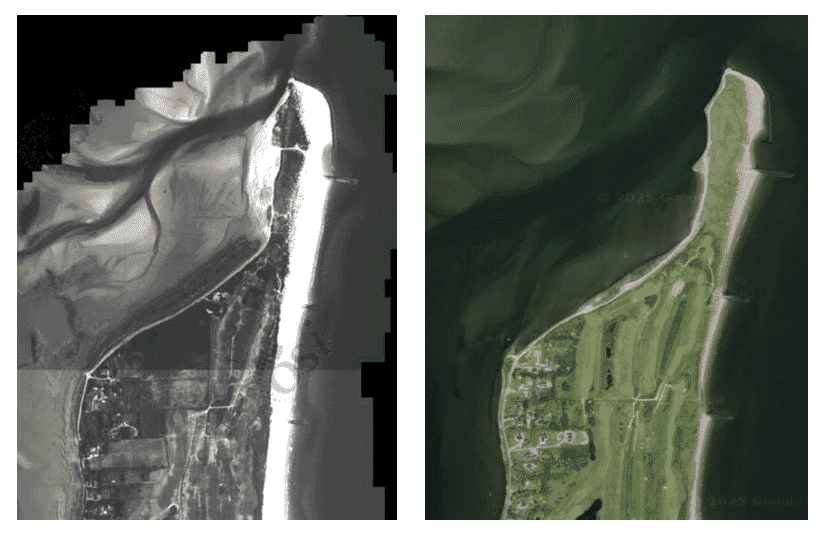
(C) The left image is an aerial map immediately north of Rosslare Village and beach taken in 1995 (MapGenie Imagery). The image on the right is of the same location in 2025 (Google Earth). You can see signs of erosion in the right image, notice the recession of the shoreline and narrowing of the beach.
The hidden cost of coastal erosion
As coastlines erode, the communities living alongside them are forced to adapt, whether through formal interventions or quieter changes to daily life. Yet, coastal adaptation is usually discussed in terms of engineering and infrastructure. However, adaptation is also something people live through in everyday life. It can shape how communities experience places they value, how people feel about environmental change, and how they imagine their future along the coast.
My PhD research explores lived experience, place attachment, and mental health in coastal communities facing this. I am interested in how gradual coastal erosion and other slow environmental changes affect people over time, not only physically and economically, but socially and emotionally as well.
Why human experience matters in adaptation
Coastal environments are deeply connected to identity, memory, and everyday routines. As a result, changes to these landscapes can affect more than just the physical coastline. Adaptation measures may alter access to familiar places, reshape daily routines or create uncertainty about the future. Even before major change occurs, people may already feel anxiety, stress, or a sense of loss connected to environmental change. Findings from a study conducted in Courtown, County Wexford, revealed that 42.7% of residents in the area felt that they had impacted by the loss of the beach, following erosion and the instalment of rock armour.
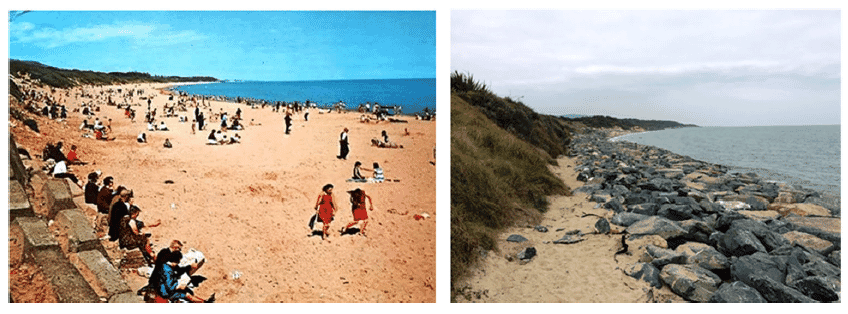
(C) The left image is the North beach at Courtown in 1967. The right image is the North beach at Courtouwn in 2015, covered in rock armour. Image from Phillips and Murphy (2021).
This is why the human dimensions of adaptation matter. Responses to climate change are not confined to technical challenges, they are also social and emotional ones. And adaptation decisions are shaped by governance, inequality, and competing priorities. Communities do not experience environmental change in the same way, and adaptation measures do not affect people equally. Therefore, recognising these differences matters if responses are to be effective, equitable, and sustainable.
Although my research is at an early stage, I hope it will contribute to a broader understanding of how coastal adaptation is experienced at the community level, particularly in relation to slow-onset environmental change. By bringing lived experience into conversations about adaptation, we can better understand not just how coastlines are changing, but how those changes are felt by the people living alongside them.
Get in touch
If you work on coastal adaptation, climate resilience, or the social side of environmental change, I would be delighted to connect and continue the conversation.