For every £1 directed toward protecting nature in 2023, £33 went toward destroying it. A new global report says businesses are both the cause of that gap and the key to closing it.
In February 2026, the Intergovernmental Science-Policy Platform on Biodiversity and Ecosystem Services (IPBES) released a landmark report. For the first time, IPBES wasn’t just documenting nature loss, it was speaking directly to business, and the message was clear: every company depends on nature, every company affects it, and now there are practical ways to measure both.
For businesses in agri-food, energy, finance and land management, sectors well represented among the Climate + Co-Centre’s nine industry partners, this report matters.
Your business relies on nature more than you think
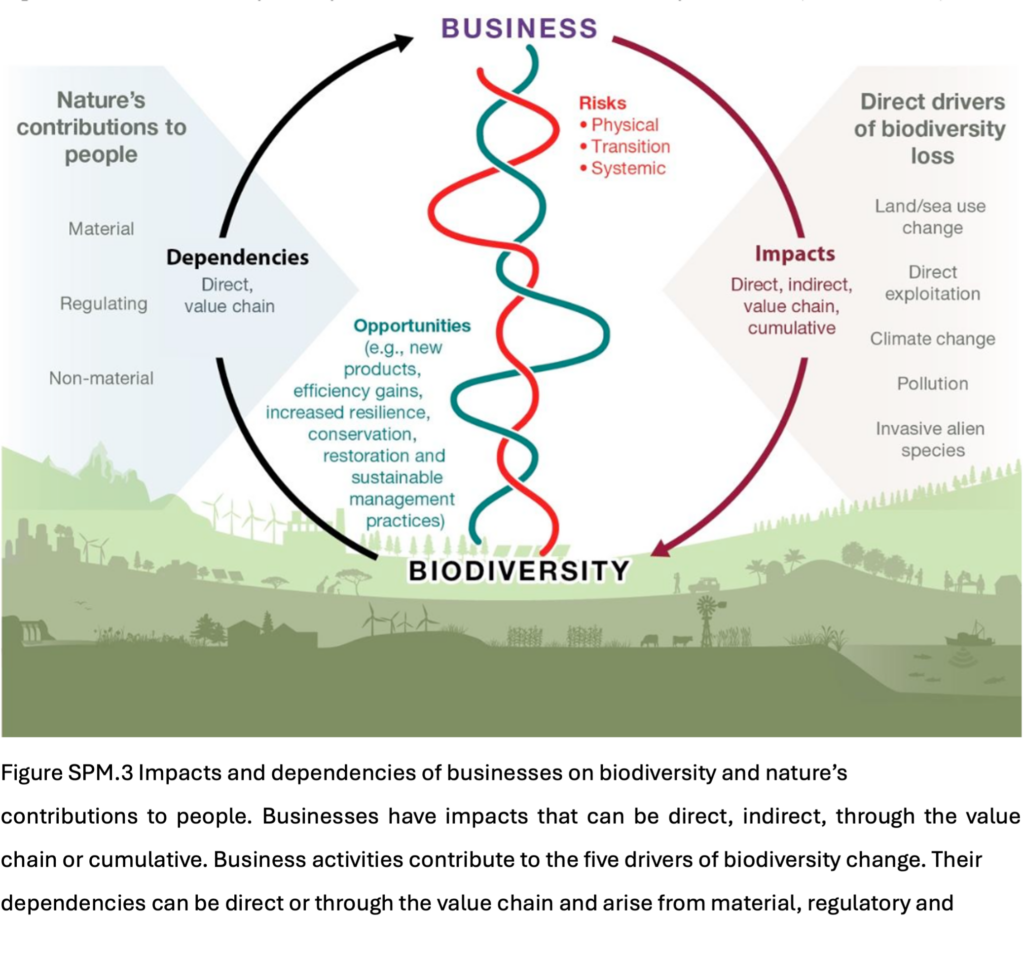
The report’s central insight is simple: how much your business relies on nature is just as big a risk as how much it harms nature, and most companies aren’t tracking either. Farms depend on bees and healthy soil. Water companies depend on forests and wetlands that filter and store water. Banks and insurers hold investments exposed to floods, droughts and crop failures. Yet fewer than 1% of publicly reporting companies even mention nature in their disclosures.
If you don’t know your supply chain depends on a healthy river system, you can’t plan for what happens when that river degrades. The IPBES report provides, for the first time, a practical framework for identifying and measuring these hidden dependencies.
How to measure what matters
One of the report’s most practical contributions is its guidance on measurement, and the core message is reassuring: you don’t need one perfect metric. Different decisions need different approaches. Assessing a specific site? You’ll need on-the-ground data and local knowledge. Screening an investment portfolio? Broader modelling tools are more appropriate. Supply chain decisions sit somewhere in between.
This is exactly the kind of work research partnerships are built for i.e., mapping where your nature risks sit, putting a value on the natural assets you depend on, and modelling what might change. The report is clear: don’t wait for perfect data. The tools available now are good enough to start, and you can build capability as you go.
What this means for Climate + Co-Centre partners
For companies already working with the Climate + Co-Centre on sustainable food systems, land use or nature-based solutions, the IPBES report validates what you’re already doing and gives you a clearer framework for reporting.
For those not yet engaged, the direction of travel is clear. The EU’s Corporate Sustainability Reporting Directive (CSRD) already requires nature-related disclosure for companies meeting its thresholds. The Taskforce on Nature-related Financial Disclosures (TNFD) framework (currently voluntary) is being built into mandatory processes across Europe and signalled for adoption in the UK. And Target 15 of the Kunming-Montreal Global Biodiversity Framework calls on governments to require large businesses and financial institutions to assess and disclose their nature-related risks by 2030. Meanwhile, over 500 organisations have already published TNFD-aligned reports, and investors increasingly expect nature disclosure as standard. The tools to get ahead of this exist now.
The Climate + Co-Centre’s research across climate, biodiversity and water can help businesses understand and measure their relationship with nature. The science is ready. The question is whether your business moves now, or waits until it has to.
